UX designer · Dhaka · open to remote and onsite
I find out what the brief got wrong before I draw the screen.
I'm Humayon Kabir, a junior UX designer in Dhaka. I design mobile and web apps, workflow first. Open to remote and onsite roles in Dhaka, with a focus on field research at product companies.

What the brief said, and what I decided
- Desktop, for students, card onlyMobile-first, for parents, with bKash EduBridge Parents hold the phone and the money, and most pay with bKash.
- Nearby cars on the mapAn availability line Route Few drivers means offer more. It keeps the map calm.
- Role
- UX designer, mobile and web apps
- Based in
- Dhaka, Bangladesh
- Tools
- Figma, Paper.design, Illustrator, Claude Code
- Languages
- Bangla (native), English (working)
Work
- 2024 and 2026
Featured case study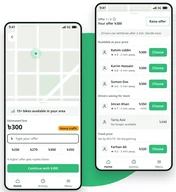
Route: a ride-sharing app for bikes, cars and CNG
Started in a 2024 internship at People Ntech, from interviews with young adults I knew. Rebuilt in 2026 as a practice project: a simulated client brief taken to a developer handover, 111 screens, with AI in the workflow.
I took the "minimal" side of a brief that also asked for 16 screens, and put fare negotiation on every vehicle type. The page lists what I decided, what I rejected, and the limits.
- 2025
Professional workFleet-management SaaS: maintenance report, overdue tasks, crew app
A web dashboard for fleet owners and mobile apps for the crews who maintain, repair and deliver their vehicles. I started as the junior designer and finished as the only designer.
I turned a paper-style maintenance report too long for one screen into a summary-first view. The design was implemented in production.
- 2026
Course project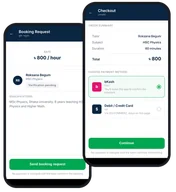
EduBridge BD: parent booking and payment flow
A tutoring marketplace brief written for the UK, rewritten for parents on Android phones in Bangladesh. One screen built as working HTML, with locked design tokens and a full bKash path.
I put the rate above the tutor, because cost had to be visible before payment method. Then I caught myself defaulting to the payment path I had built more error states for.
- Practice
Personal project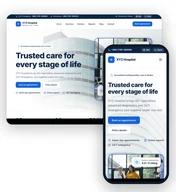
XYZ Hospital: a fictional hospital website, designed and built
A practice project of my own, designed in Figma and built with AI: three-step booking, report lookup, and Bangla and English throughout. The working site and the Figma file are linked.
How I work
How I work with AI, from brief to deliverables.
Read every version of the brief together
Contradictions only show up side by side. On EduBridge the brief and the PM thread disagreed in five places. I took a side on each and wrote it down.
Output A written decision on each contradiction
Fill the gaps and clear up the confusion
List what is missing or unclear, then ask until the whole scenario makes sense. On EduBridge I sent four numbered questions to the PM before I designed. What nobody could answer, I flagged as open instead of guessing.
Output Written answers, plus a list of what is still open
Map the flow before drawing it
Sometimes by hand, screen by screen. Then I sit with developers until they confirm it can be built. I did this for the crew app before any screen was visualised.
Output A flow the developers confirmed can be built
Lock the system before the screens
Tokens come first, so the spacing and type scale are decided before anyone, human or AI, invents their own. Developers get the tokens and a working HTML prototype, not only a static Figma file.
Output Design tokens and a working HTML prototype
Direct AI and reject what does not fit
Claude Code writes the markup fast. The layout, the copy and what gets cut are my choices. On EduBridge it wrote "Payment verified". I changed it to "Booking confirmed", because a parent needs to know the booking worked.
Output Screens and copy I chose, with the rest cut
Hand over everything a developer needs
Not only a Figma file. On Route, a developer gets 111 screens and a clickable prototype, three specs, 59 tokens and 32 icons, and HTML review pages built from the tokens. They also get a list of decisions already made, a list of what is not decided, and who owns what is left.
Output A handover package developers can build from
Experience
Jr. UI/UX Designer, then UI/UX Designer
Llamamind.io, building Fleetblox, a fleet-management platform
- Redesigned the maintenance report as a summary-first view. It was implemented in production.
- Designed the overdue-task flow for the crew app and checked it with developers before handoff.
- Became the only designer when my senior left. Designed the crew app, the store screenshots and looping animations for the marketing site.
- Worked closely with the Bangladeshi developers, took part in brainstorm sessions, and worked in large, dense design files.
UI/UX Design Intern
People Ntech
- Built my Figma foundations: components, libraries, assets and variables.
- Applied them to the ride-sharing app Route, from team interviews to screens.
- Finished with a Certified Jr. UI/UX Designer certificate.
Where I'm still growing
Knowing where my edges are saves everyone time.
- Localization for Bangladesh is something I have studied and applied in a course project. I have not yet shipped it to real users.
- I am not a decorative visual designer. Hero imagery and illustration that is not tied to a workflow is not where I add the most value.
- I am not a marketing-website specialist. My strength is mobile and web applications.
Contact
Email me about UX roles, especially onsite roles with field research at product companies, or about a brief you suspect is wrong.
Best fit: workflow-heavy tools (SaaS, dashboards, field operations) or products built for Bangladeshi users.
- Email: humayonison@gmail.com
- LinkedIn: linkedin.com/in/humayon-is-on
- Behance: behance.net/humayonison (older UI design work)